As an Amazon Associate, we earn from qualifying purchases. Some links on this site are affiliate links at no extra cost to you. Our recommendations are based on thorough research and editorial judgment.

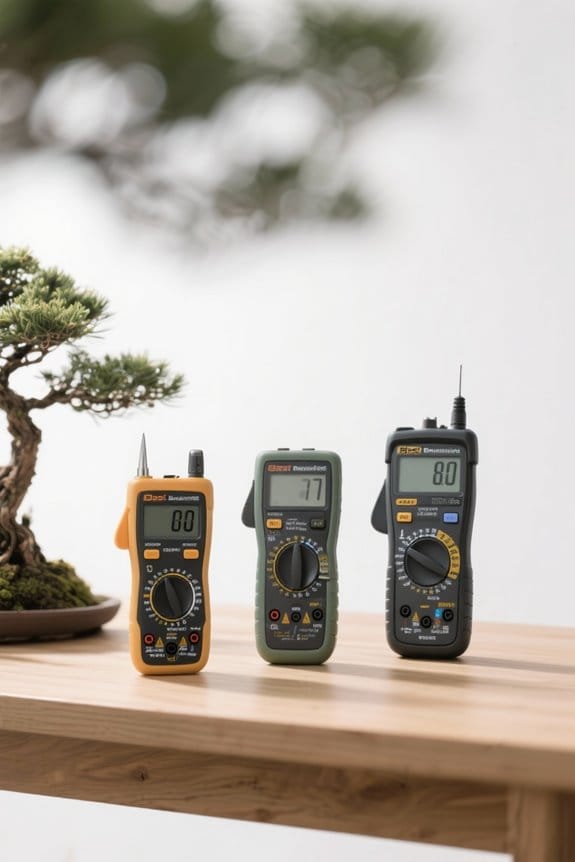
3 Best Bonsai Multimeters for Precision and Performance in 2026

If you’re looking for precision and performance in bonsai multimeters, consider the Fluke 302+ Digital Clamp Meter, Fluke 323 Clamp Meter, and Klein Tools CL120 Digital Clamp Meter. Each one measures AC current up to 400A and voltages up to 600V. They offer features like true RMS sensing and auto-ranging. These tools are compact and user-friendly, making them great for both beginners and pros. Keep exploring to find out more about their benefits and specifications!
Key Takeaways
- The Fluke 302+ offers excellent accuracy, measuring up to 400A AC current and 600V voltage, ideal for precise troubleshooting.
- The Fluke 323 features true RMS sensing and non-contact measurement, making it perfect for electricians handling diverse load types.
- Klein Tools CL120 includes auto-ranging technology and a backlit display, ensuring easy use and clear readings in various environments.
- Compact designs and features like magnetic hangers enhance portability and convenience for users in tight spaces.
- Comprehensive warranties and reliable customer support significantly improve user experience and product reliability over time.
Fluke 302+ Digital Clamp Meter
Sale

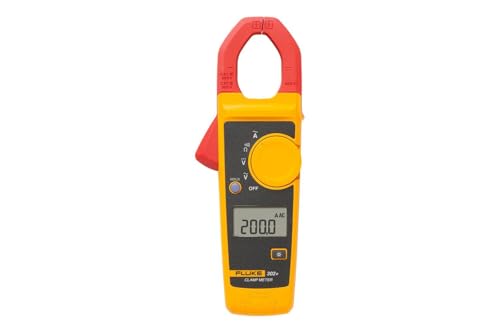
Fluke 302+ Digital Clamp Meter, 30mm Jaw, Measures AC Current to 400A, Measures AC/DC Voltage to...
- Compact, easy-to-use clamp meter with 30 mm large jaw taking measurements on large conductors
- Measure high AC current loads up to 400 A for a wide range of applications
- High accuracy of 1.8 % for troubleshooting tasks
If you’re looking for a reliable tool to measure various electrical parameters, the Fluke 302+ Digital Clamp Meter is an excellent choice. It can measure AC current up to 400A and AC/DC voltage up to 600V. You’ll also find functions for measuring resistance, continuity, and capacitance, making it versatile for many tasks. With a compact design featuring a 30 mm jaw, it comfortably fits around wires. Plus, its high accuracy of 1.8% guarantees precise troubleshooting. This meter is rated CAT IV 300 V and CAT III 600 V for safety. Remember, it comes with a two-year warranty, giving you confidence in your investment.
Best For: Professionals and hobbyists looking for a versatile, high-accuracy clamp meter for electrical measurements.
Pros:
- High AC current measurement range of up to 400A, suitable for a wide range of applications.
- Compact design with a 30 mm jaw for easy access to tight spaces.
- Two-year warranty provides assurance of product reliability.
Cons:
- Limited to measuring up to 600V, which may not suffice for high-voltage applications.
- The accuracy rating of 1.8% may not meet the needs of advanced users requiring higher precision.
- Does not include advanced features found in more expensive models, such as data logging.
Fluke 323 Clamp Meter for Electricians
Sale

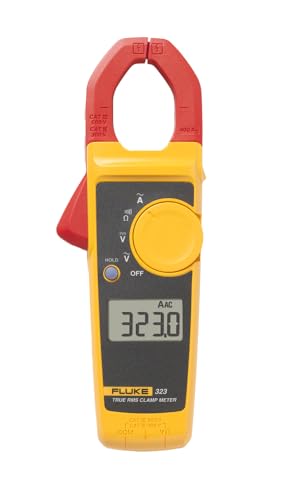
Fluke 323 Clamp Meter for Commercial/Residential Electricians, Measures AC Current to 400 A & AC/DC...
- Digital clamp meter measures AC current to 400 amp, AC and DC voltage to 600 v, and resistance to 4 kilo ohms. Does not measure DC current
- The true RMS sensing meter provides accurate readings when measuring linear or non-linear loads, regardless of waveform, Measures resistance to 4 kΩ with continuity...
- Jaw opening measures current in a conductor up to 30 millimeter without touching or interrupting the circuit. Resistance accuracy: 1.0% ± 5 digits
The Fluke 323 Clamp Meter is an excellent choice for electricians working in both commercial and residential settings, thanks to its ability to measure AC current up to 400 A and AC/DC voltage up to 600 V. With this tool, you can also measure resistance up to 4 kΩ, making it versatile for various tasks. Its jaw opening allows you to measure current in conductors up to 30 mm, all without direct contact. Plus, its True RMS sensing guarantees accuracy across different loads. Don’t forget to utilize its audible continuity sensor for verifying circuits efficiently, which is especially helpful during troubleshooting.
Best For: Electricians working in commercial and residential environments who require accurate measurements of AC current, AC/DC voltage, and resistance.
Pros:
- True RMS sensing ensures precise measurements across both linear and non-linear loads.
- Jaw opening allows for non-contact current measurement in conductors up to 30 mm, enhancing safety and convenience.
- Audible continuity sensor aids in quick circuit verification, simplifying troubleshooting.
Cons:
- Does not measure DC current, limiting its functionality for certain applications.
- Resistance measurement accuracy may not meet the needs of very precise applications due to a 1.0% margin.
- Limited to 4 kΩ for resistance measurement, which may not suffice for some advanced electrical tasks.
Klein Tools CL120 Digital Clamp Meter
Sale

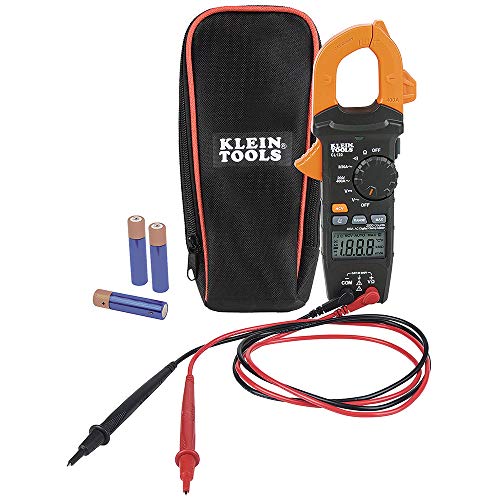
Klein Tools CL120 Digital Clamp Meter, Auto-Ranging 400 Amp AC, AC/DC Voltage, Resistance...
- VERSITILE CLAMP METER: Measures AC current and NCVT via clamp; AC/DC voltage, resistance, and continuity via test-leads
- NON-CONTACT VOLTAGE TESTING: Integrated into the clamp jaw for convenient electrical testing
- BACKLIT DISPLAY: LCD shows clear readings in low-light conditions for enhanced visibility

A standout feature of the Klein Tools CL120 Digital Clamp Meter is its ability to measure AC current up to 400 Amps, making it an excellent choice for electricians and DIY enthusiasts alike. You’ll appreciate the auto-ranging technology, which helps select the correct measurement range effortlessly. This meter measures AC and DC voltage, resistance, and continuity. Plus, it includes a non-contact voltage tester in the clamp jaw for quick checks. The backlit LCD guarantees readings are clear, even in dim light. With a handy test lead holder and optional magnetic hanger, you’ll find it easy to use during projects.
Best For: Electricians and DIY enthusiasts looking for a reliable and versatile measuring tool for electrical testing.
Pros:
- Accurate measurements with auto-ranging technology for effortless range selection.
- Integrated non-contact voltage tester for quick and safe voltage checks.
- Backlit LCD display provides clear readings even in low-light conditions.
Cons:
- Limited to measuring AC current up to 400 Amps, which may not suffice for higher applications.
- The auto-power off feature could be inconvenient if frequent measurements are needed.
- Test leads may not be as durable as some users expect for heavy-duty use.
Factors to Consider When Choosing a Bonsai Multimeter
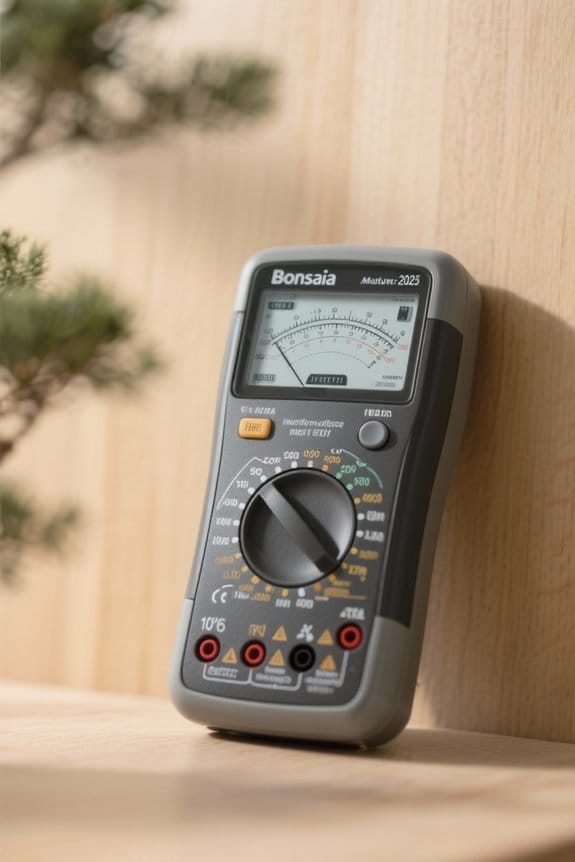
When you choose a bonsai multimeter, consider several important factors. These include the measurement capability range, safety ratings, and how readable the display is. Additionally, think about any extra features you may need and the size of the multimeter for portability.
Measurement Capability Range
Selecting a bonsai multimeter includes understanding its measurement capability range, which directly impacts your projects. When you choose one, pay attention to the AC current measurement range, ideally from 400A down to lower values. Verify the multimeter measures both AC and DC voltage, with a capability of up to 600V, giving you versatility. Resistance measurements should go up to 4 kΩ to help diagnose circuit issues effectively. Look for true RMS sensing, as this guarantees accuracy with both linear and non-linear loads. It’s also helpful if the multimeter includes features like continuity testing and capacitance measurement, offering valuable insights when troubleshooting electrical problems. A well-equipped multimeter can simplify your work and enhance your results!
Safety Ratings Required
Choosing a bonsai multimeter with the right safety ratings is essential for guaranteeing your safety and the device’s reliability. Start by looking for multimeters with CAT III ratings, which are perfect for distribution panels. If you need to measure at the source of a low-voltage supply network, aim for a CAT IV rating. CAT IV multimeters, rated for up to 300V, are better for high-voltage applications, offering greater protection against voltage surges. Always check if the multimeter meets IEC safety standard 61010-1. This guarantees the device is safe for specific tasks. By choosing a multimeter that meets these safety standards, you boost your confidence and minimize the risk of electrical shocks while you work.
Display Readability Features
Getting the right display readability features in a bonsai multimeter makes a big difference in your experience and accuracy. Look for a backlit LCD display; it enhances visibility, especially in low-light conditions. High-contrast screens sharply define text and numbers, making them easy to read. You’ll also benefit from a larger display size; it prevents eye strain when viewing measurements. Consider models with auto-ranging technology, as this feature automatically adjusts to the correct scale, minimizing misinterpretation. Additionally, measurement hold and max hold functions freeze the display, helping you record or analyze readings effectively. By choosing a multimeter with these features, you’ll greatly improve your measurement accuracy and overall user experience.
Additional Functionalities Offered
When exploring additional functionalities in bonsai multimeters, you’ll discover features that greatly enhance their utility. Some models allow you to measure capacitance and frequency, which can help diagnose electronic circuit issues. A non-contact voltage tester feature is also common, letting you detect live wires safely without touching them. Consider a multimeter with True RMS capability, as that gives accurate measurements for both linear and non-linear loads. Features like data hold and max hold let you capture peak values for easier troubleshooting. Finally, look for integrated backlit displays; they improve visibility in low light, making your electrical work safer and more efficient. These functionalities can make your multimeter much more versatile and practical.
Size and Portability Considerations
Size and portability often play essential roles in your decision-making process for selecting a bonsai multimeter. Consider the weight and dimensions; a compact design makes handling and storage easier, especially in tight spaces. Look for features enhancing portability, like a carrying case or a built-in test lead holder. If you’re opting for a clamp meter, make sure its jaw opening accommodates conductors up to 30 mm, giving you versatility. Additional features, like magnetic hangers or hooks, enable hands-free operation in different environments. Don’t forget an auto-power-off function; this can save battery life, guaranteeing reliability during transport and reducing the hassle of frequent battery changes. Choose wisely, and you’ll have a multimeter that’s easy to carry and use.
Warranty and Support Terms
Choosing the right bonsai multimeter doesn’t stop at size and portability; warranty and support terms are just as important. When you make your purchase, check the warranty length, which usually ranges from one to three years. This coverage protects you against manufacturer defects, giving you peace of mind. Look for brands that offer responsive customer support, as good service can help with troubleshooting and warranty claims. Some brands even provide extended warranties for a bit more money, which can be a smart way to safeguard your investment long-term. Don’t forget to read customer reviews—they offer valuable insights into how well warranty service works and how effectively claims are handled in real situations.
Frequently Asked Questions
What Is the Average Lifespan of a Bonsai Multimeter?
The average lifespan of a bonsai multimeter is typically around five to ten years, depending on usage and care. To extend its life, store it in a dry, cool place and avoid exposing it to moisture. Regularly check the battery and replace it when necessary. If you handle it gently and keep it clean, you’ll likely enjoy accurate readings for many years. Invest time in maintenance; it pays off in longevity!
Can Bonsai Multimeters Measure Non-Electrical Parameters?
Bonsai multimeters can measure non-electrical parameters, like temperature, humidity, and soil moisture. This versatility creates valuable insights for your bonsai care. For instance, use the moisture probe to check soil levels, ensuring your bonsai thrives. Just remember, while they excel in electrical readings, not all models include non-electrical functions, so it’s essential to check specifications. Explore features carefully, and you’ll find the perfect tool for nurturing your miniature tree.
How Do I Calibrate My Bonsai Multimeter?
To calibrate your bonsai multimeter, first, confirm it’s turned off. Then, locate the calibration adjustment screw, usually found on the back or side. Use a known reference voltage, like a 9V battery. Turn on the multimeter, set it to voltage measurement, and connect the leads to the battery. Adjust the screw until the reading matches the battery voltage. Repeat this for other settings like resistance and current, confirming accuracy in all measurements.
Are Bonsai Multimeters Waterproof or Water-Resistant?
Bonsai multimeters typically aren’t waterproof, but many offer water-resistant features. When you’re working outdoors, look for models with an IP rating, which indicates their level of protection against moisture. For example, an IP54 rating means it’s protected from splashes. Always avoid exposing your multimeter to heavy rain or submerging it in water. If you keep it dry and store it properly, you’ll extend its life considerably and maintain accurate readings.
What Warranty Options Are Available for Bonsai Multimeters?
Most bonsai multimeters come with a warranty, usually ranging from one to three years. You might find options like a limited warranty, covering defects in materials and workmanship. Some brands even offer extended warranties for additional peace of mind. Always read the warranty terms carefully before purchasing, so you know what’s covered. This way, you’ll be prepared in case your multimeter requires repairs or replacement down the line. Happy measuring!


