As an Amazon Associate, we earn from qualifying purchases. Some links on this site are affiliate links at no extra cost to you. Our recommendations are based on thorough research and editorial judgment.

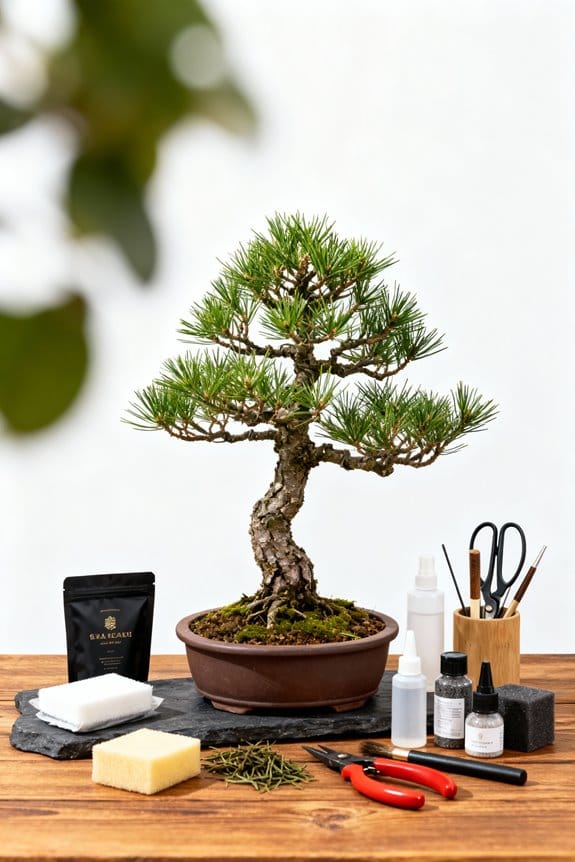
Long Term Care Plan for a Pine Bonsai in Training

Creating a long-term care plan for a pine bonsai in training involves several key elements. Confirm full sun exposure and good drainage to promote healthy growth. Water every 1-3 days, using dechlorinated water, and apply an 8-9 month time-release fertilizer in spring. Prune regularly to maintain shape, especially during growth phases. Monitor for pests like aphids and spider mites. This approach builds a robust tree. To enhance your knowledge, explore detailed care tips and seasonal strategies.
Key Takeaways
- Ensure full sun exposure to promote healthy growth and minimize needle length in your pine bonsai.
- Implement a consistent watering schedule, soaking the pot thoroughly every 1-3 days during active growing seasons.
- Fertilize with a time-release feed in early spring and consider a low-nitrogen feed in fall for root stability.
- Prune vigorously to shape and maintain form, focusing on candle growth in early summer and inspecting for excess growth regularly.
- Conduct regular health checks for pests, ensuring good drainage and sun exposure to prevent root rot and other health issues.
Importance of Proper Growing Conditions
Proper growing conditions play an essential role in the health and development of bonsai trees. Pine bonsai, in particular, thrive when provided with full sun exposure, promoting healthy growth and minimizing needle length. Ensuring proper watering is imperative; over-watering can lead to root rot while good drainage protects the roots. Fertilization varies, as weak trees may require year-round nutrients, while healthy trees benefit from targeted feeding during early spring to summer. Repotting should occur in spring for two-flush pines or late summer for one-flush varieties, encouraging vigorous root growth. Implementing a regular pest management routine with organic solutions can help protect bonsai from common pests, ensuring their health and longevity. Finally, consistently monitoring for pests and diseases, such as aphids and root rot, is essential to maintaining the overall well-being of pine bonsai. Proper care leads to flourishing trees.
Watering and Fertilization Strategies
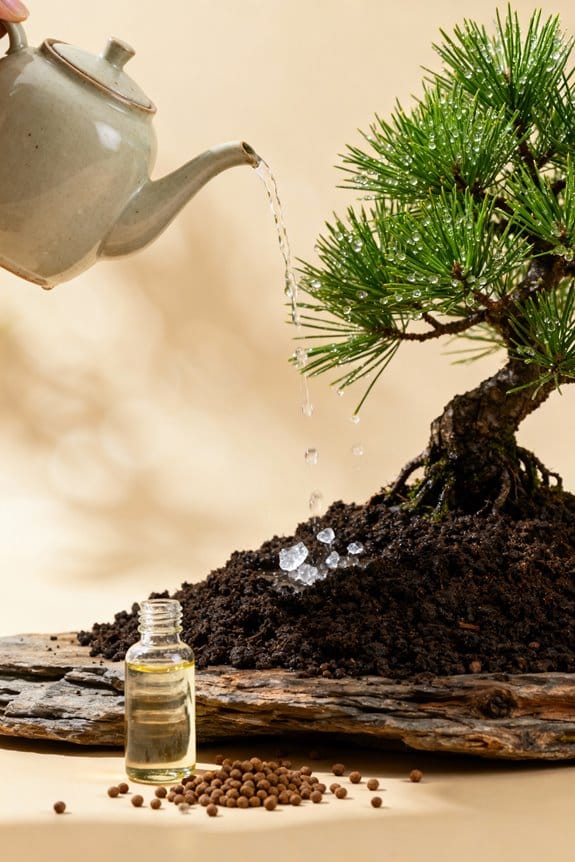
While caring for bonsai trees, understanding the right watering and fertilization strategies is crucial for their longevity. Watering should occur every 1-3 days during the growing seasons—spring, summer, and fall—while frequency decreases in winter dormancy. It is advisable to use dechlorinated water, which can be achieved by letting tap water sit for 24 hours or utilizing rainwater. In hot weather, soaking the pot for up to 30 minutes guarantees deep hydration for healthy root growth. For fertilization, apply an 8-9 month time-release feed in early spring to support healthy trees. Consider a 0-10-10 fertilizer in the fall to promote root growth and prepare flowering trees for winter. Organic fertilizers can also enhance overall health. For optimal bonsai health, choosing fertilizers with balanced NPK ratios like 3-1-2 or 2-2-3 can provide essential nutrients for sustained growth and vitality.
Pruning Techniques for Healthy Growth

How can bonsai enthusiasts guarantee their trees develop strong, healthy shapes? Pruning is essential for maintaining both healthy growth and balanced aesthetics. For single-flush pines, enthusiasts should prune back candles longer than one inch by early to mid-June. Two-flush pines require decandling in June, encouraging a second flush of growth with shorter needles and compact foliage. During summer, regular inspections for excess growth are crucial. Prune secondary candle whorls down to two branches to enhance fork development, ensuring the tree maintains its design. Heavy pruning for all native Japanese pines should occur from late August through October to support vigorous growth and remove overcrowding. Always retain 2-3 leaves at the base when pruning to promote overall tree health. Using high-carbon steel blades ensures cleaner cuts, contributing to healthier plants by reducing the risk of infection or disease.
Seasonal Maintenance Phases
Seasonal maintenance for bonsai trees consists of distinct phases, each designed to support the tree’s health and beauty throughout the year. In early spring, the focus shifts to pruning vigorous new growth, ensuring the bonsai maintains its desired form. From spring to early summer, careful pinching helps control branch length, complementing layering and cuttings for propagation. As summer maintenance begins, vigilant monitoring for drought stress is essential, alongside repotting for those robust pines needing extra attention. In autumn, the shift includes fertilization with low nitrogen to stabilize roots, preparing the bonsai for winter dormancy. Throughout these phases, observing growth patterns is key to fostering a vigorous and aesthetically pleasing pine bonsai. Incorporating a germination dome with humidity control can enhance the growing environment during propagation and initial growth stages of bonsai maintenance.
Pest and Disease Management
To guarantee the health and vigor of pine bonsai, it is essential to implement effective pest and disease management practices. Regular health checks should be conducted to monitor for common pests such as aphids and spider mites. Early detection is essential for effective management, so inspect your bonsai frequently. Additionally, make sure your plant receives full sun exposure while avoiding over-watering, as excess moisture can lead to root rot and other fungal diseases. Good drainage is critical to maintain soil health. Protect trees from harsh winter conditions to ensure they remain robust and healthy throughout the year. If infestations occur, apply specific pesticides after consulting bonsai care experts. Remember, a little diligence goes a long way in keeping your pine bonsai thriving and free from pests and diseases.
Long-term Development Goals
Long-term development goals for bonsai, especially pine varieties, are vital for achieving a mature and aesthetically pleasing specimen. To start, select a healthy seedling with strong branches and good trunk taper. Maintain a balanced growth rate by following seasonal maintenance practices, like proper watering and fertilization during active growth. Pruning bonsai is important; use candle management to guarantee healthy needle retention in single-flush pines while encouraging a second flush of growth in double-flush types. Additionally, schedule repotting bonsai every 2-3 years to improve root development. Finally, monitor environmental conditions closely. Incorporating bonsai wall art into your environment can enhance the aesthetic appeal of your bonsai display area. Adjust sunlight exposure as necessary to help your pine thrive, particularly during high summer and winter dormancy for peak health and growth.
Frequently Asked Questions
What Is the Rule of 3 in Bonsai Tree?
The Rule of 3 in bonsai emphasizes balance through triads in branching, pruning techniques, and styling. It enhances visual appeal and influences watering frequency, pest control, and soil composition, promoting healthy growth patterns and ideal container selection.
How to Care for a Pine Tree Bonsai?
Like a sculptor chiseling marble, caring for a pine tree bonsai involves understanding its light requirements, watering schedule, soil composition, and nutrition; employing proper pruning techniques, pest control, pot selection, fertilization methods, and winter protection guarantees growth.
How Long Does It Take to Train a Bonsai Tree?
Training a bonsai tree typically spans several years, influenced by species differences, growth stages, and environmental factors. Effective pruning methods, fertilization schedules, watering needs, wiring effects, and pest management can markedly impact the training timeline.
How to Resuscitate a Bonsai Tree?
When the chips are down, resuscitating a bonsai tree involves proper watering techniques, root care, and pruning methods. Guarantee ideal soil types, humidity levels, light requirements, and a fertilization schedule to promote recovery and healthy growth.


